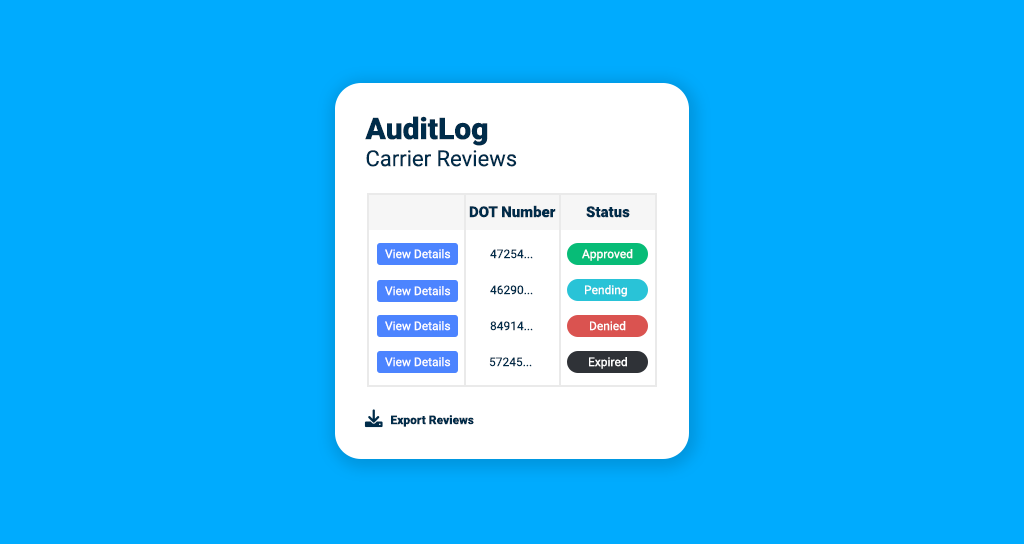

Today’s freight brokers need more than authority and insurance checks—they need defensible, auditable carrier vetting processes as the recent Supreme Court ruling increases litigation risk around carrier selection.
What You Need to Know
The Supreme Court’s unanimous decision in Montgomery v. Caribe Transport II may become one of the most consequential broker-liability rulings the transportation industry has seen in years. While the decision does not impose strict liability on brokers, it does significantly raise the importance of demonstrating reasonable care in carrier selection and documenting that process in a consistent, defensible way.
Key highlights
- The ruling increases the likelihood that negligent-selection claims against brokers will proceed under state law
- The decision places greater emphasis on maintaining auditable documentation of carrier selection, compliance, and safety reviews as a core legal defense.
- Carrier vetting must extend beyond FMCSA registration to include safety history, crash data, insurance adequacy, and ongoing monitoring.
- Industry executives expect insurance premiums to rise sharply, with some warning that brokers may need $5–10 million in per-incident coverage — costs that could disproportionately impact smaller brokers and ultimately flow through the supply chain to shippers and consumers.
- Industry groups are expected to push for federal legislation or FMCSA standards establishing clearer national broker safety requirements.
Implications for Brokers
Freight brokers have always had to move quickly, and a delayed carrier decision can mean a missed pickup. But speed has never eliminated the need for due diligence. Following the U.S. Supreme Court’s unanimous decision on May 14, 2026 in Montgomery v. Caribe Transport II, LLC, that balance between speed and diligence is likely to face even greater scrutiny.
While the ruling does not create strict liability for brokers or mean every accident automatically creates broker exposure, it does increase the focus on exercising reasonable care in carrier selection. The Court held that state-law negligent hiring and selection claims against freight brokers are not preempted by the Federal Aviation Administration Authorization Act because those claims can fall within the law’s safety exception. In practical terms, claims tied to a broker’s selection of a motor carrier may now be allowed to proceed when safety concerns are involved. Legal commentators have already noted that this will increase scrutiny of carrier vetting practices, safety-rating review processes, and documentation protocols.
Additionally, there is also renewed industry discussion around what actually defines a “safe” carrier. While brokers are facing increased scrutiny around carrier selection decisions, FMCSA has historically stated that its role is not to certify carriers as safe, but rather to identify carriers considered unsafe. Industry estimates suggest that roughly 94% of active interstate carriers do not hold a formal FMCSA safety rating, largely because the agency lacks the resources to conduct audits across the full carrier population.
As a result, brokers often rely on a combination of FMCSA data, inspection history, operating behavior, fraud indicators, and internal risk controls to make carrier qualification decisions in an environment where expectations around documentation and defensible processes continue to evolve. The ruling signals likely downstream impacts for brokerage operations, including rising insurance costs, increased liability risk, and growing pressure to maintain documented and defensible carrier vetting processes.
One-time Authority and Insurance Checks Not Enough
Traditional carrier onboarding has often focused on whether a carrier is legally eligible to haul freight. Is the motor carrier authority active? Is insurance on file? Has the carrier packet been signed?
Those checks still matter, but they may no longer answer the more important operational question: is this carrier an appropriate choice for this load, this customer, this commodity, and this lane? Have there been recent safety issues or changes on their profile?
The Supreme Court case underscores why that distinction matters. According to reporting on the case, the underlying lawsuit alleges that the broker selected a carrier despite red flags, including prior crashes and a driver with a history of careless driving. The ruling does not determine liability, but it does allow the claim to move forward.
This creates a new operational reality for brokers. If a claim arises, the question may not simply be whether the carrier was authorized. It may become:
- What did the broker review?
- Were safety indicators considered?
- Were exceptions escalated?
- What standards were applied?
- Why was the carrier approved?
- Was the decision documented?
Carrier Selection Must Include Safety Records
In light of the ruling, strong carrier vetting must now include a broader assessment of carrier risk. Looking beyond active authority and valid insurance, brokers are increasingly evaluating FMCSA safety data, inspection history, out-of-service rates, authority age, identity verification, equipment ownership, and historical operating behavior as part of the carrier selection process. Fraud indicators and suspicious profile changes may also warrant additional scrutiny before freight is tendered.
A carrier may technically be authorized to haul freight while still posing operational or safety-related risks that deserve additional scrutiny. While this may not always mean the carrier should be automatically rejected, it may mean the broker needs additional documentation, enhanced review, supervisor escalation, different load assignment criteria, or increased shipment monitoring requirements.
At this crucial point operational discipline becomes critical. Carrier qualification should not rely solely on informal decision-making or individual judgment under pressure to cover freight quickly. Brokers increasingly need standardized workflows that apply consistent criteria, escalate exceptions appropriately, and maintain records of what was reviewed before freight was tendered.
Documentation and Auditability Now Critical
One of the biggest operational shifts resulting from the ruling may be the growing importance of documentation and auditability beyond the carrier selection decision itself. Brokers may need to show:
- What information was reviewed at the time
- Whether safety signals existed
- Whether exceptions were escalated
- Why the carrier was approved
- What monitoring processes were followed
This creates pressure for more structured and repeatable workflows. Manual processes, disconnected systems, spreadsheets, and tribal knowledge can become difficult to defend in a legal environment focused on operational diligence and reasonable carrier selection practices. Technology platforms can help brokers standardize workflows, centralize documentation, automate monitoring, and create audit trails that are difficult to maintain manually at scale.
Insurance Costs Likely to Rise
The ruling is expected to have implications beyond litigation alone. Industry observers anticipate increased underwriting scrutiny, rising broker insurance costs, and growing pressure for more formalized carrier-risk management practices. Insurers may place greater emphasis on documented vetting standards, monitoring processes, fraud prevention controls, and operational auditability when evaluating broker risk exposure. Underwriters may increasingly evaluate:
- Carrier vetting procedures
- Safety review workflows
- Compliance documentation
- Fraud prevention controls
- Monitoring processes
- Exception handling
- Auditability of carrier decisions
Larger brokers with mature compliance infrastructure may be better positioned to absorb or justify increased operational costs. Smaller brokers operating on tighter margins could face greater pressure if insurance premiums rise materially.
This is not, however, strictly about broker size. The bigger differentiator may be operational maturity. The ruling likely creates a competitive advantage for brokers with strong operational discipline, documented processes, scalable workflows, and the right technology infrastructure in place.
Descartes MyCarrierPortal™ — Front-Line Defense
As brokers look to operationalize more consistent carrier-risk workflows, technology platforms provide the opportunity to standardize vetting, automate monitoring, and maintain audit trails at scale. Descartes MyCarrierPortal is one example of how technology can support the frontlines. The solution helps brokers address the exact carrier-selection and monitoring risks highlighted in Montgomery by creating a documented, defensible vetting process.
- Structured carrier vetting: Customizable risk assessments, identity verification, VIN/TIN matching, and carrier safety insights help identify red flags before freight is tendered.
- Defensible documentation: Timestamped records create contemporaneous evidence that brokers performed a formal carrier review process.
- Continuous monitoring: Automated updates on insurance status, safety ratings, and regulatory compliance support ongoing oversight after onboarding.
- Community intelligence: Incident reports and broker feedback can surface emerging carrier risks before they appear in FMCSA data.
- Automated COI verification: Continuous certificate-of-insurance monitoring helps brokers detect lapses or inadequate coverage with minimal manual intervention.
- Litigation readiness: The platform converts informal due diligence into a centralized system of record that can support broker defenses in negligent hiring claims.
Want to know more?
Descartes MyCarrierPortal helps in reducing exposure to fraud, safety and compliance gaps.
Fraud Prevention and Safety Risk Increasingly Overlap
Carrier fraud and negligent-selection concerns may seem like separate issues, but operationally they are becoming increasingly connected. The same gaps that allow fraudulent actors into a network can also weaken a broker’s ability to demonstrate a reasonable and defensible carrier selection process. Identity fraud, double brokering, borrowed authority, suspicious profile changes, VoIP phone numbers, and equipment inconsistencies are not only fraud concerns. They also create uncertainty around who is actually hauling the freight.
Risk Does Not End When a Load is Tendered
Even carriers that pass onboarding can create risk later in the shipment lifecycle. Loads can be double brokered after tender. Equipment can change. Tracking can be manipulated. Drivers can deviate from routes. Fraudulent actors can spoof location data or misrepresent shipment activity. As risk exposure increases, visibility has evolved beyond customer service and shipment tracking. It is increasingly becoming part of broader transportation risk management strategies.
Descartes MacroPoint™ FraudGuard uses visibility and shipment event data to help brokers proactively identify potential fraud indicators and suspicious shipment behavior during transit. Capabilities such as route deviation alerts, unusual stop monitoring, spoofing detection, suspicious carrier indicators, and historical risk insights can help brokers identify issues earlier and respond more quickly. Such a layered approach matters because effective risk management increasingly extends across the full shipment lifecycle:
- Carrier onboarding
- Carrier qualification
- Pre-pickup verification
- In-transit monitoring
- Exception management
- Post-load documentation
As brokers look to modernize compliance and risk management workflows, platforms like Descartes can help centralize carrier vetting, fraud prevention, monitoring, and visibility processes into more consistent and auditable operational workflows.
Building Defensible Carrier Vetting Processes
Risk cannot be eliminated entirely; however, what matters is having a process that is consistent, documented, scalable, and operationally defensible. For many brokers, that means:
- Defining formal carrier qualification standards
- Reviewing safety indicators consistently
- Escalating exceptions appropriately
- Verifying carrier identity and equipment details
- Monitoring shipments in transit
- Maintaining audit trails and documentation
- Applying stronger controls for high-risk freight or suspicious activity
The transportation industry has historically prioritized speed and operational execution. While these qualities still matter, in today’s environment, brokers are being expected to pair operational efficiency with documented, defensible risk-management practices. Carrier authority and insurance remain foundational requirements, but they are no longer sufficient on their own. Safety performance, identity validation, fraud prevention, visibility monitoring, and auditable workflows are becoming core components of modern freight brokerage operations.
In a post-Montgomery environment, the brokers best positioned to succeed are likely the ones who combine agility with consistent, defensible operational discipline.